
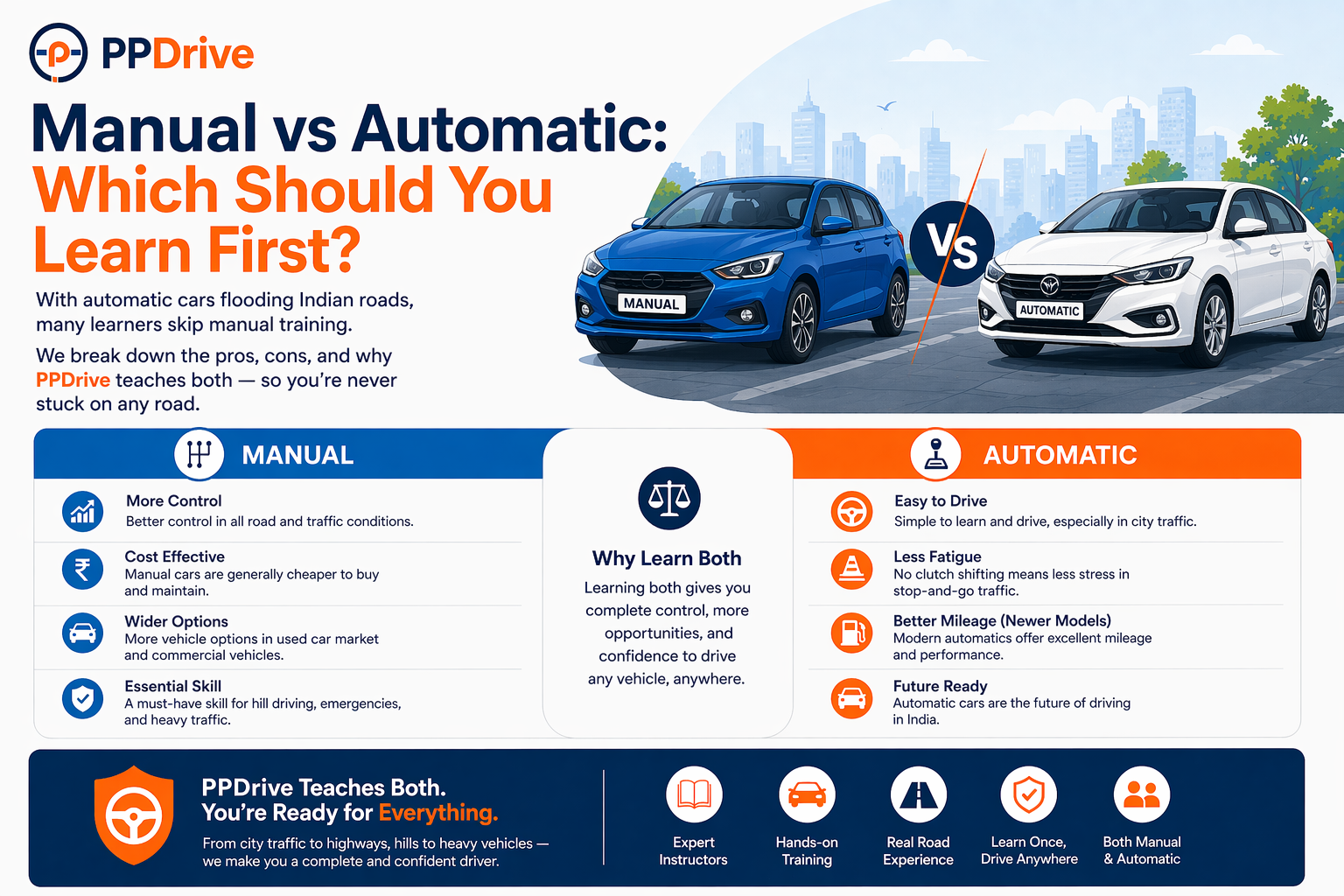
The Great Transmission Debate
With automatic cars flooding Indian roads, first-time learners face a crucial question: should I learn manual or automatic? The answer isn't as simple as you might think, and making the wrong choice can limit your driving options for years.
At PPDrive, we've trained over 10,000 students, and we've seen how this decision impacts their driving journey. Here's everything you need to know to make the right choice.
Understanding the Difference
Manual Transmission
Manual cars require you to manually shift gears using a clutch pedal and gear lever. You control when the car changes gears based on speed, road conditions, and engine sound.
How it works: Press clutch → Select gear → Release clutch while applying accelerator → Repeat as speed changes
Automatic Transmission
Automatic cars shift gears automatically based on speed and engine load. You only control the accelerator and brake — no clutch pedal, no gear shifting.
How it works: Select D (Drive) → Press accelerator → Car handles everything else
Manual Transmission: Pros and Cons
Advantages of Learning Manual First
- Universal skill: Once you learn manual, you can drive ANY car — manual or automatic. The reverse isn't true.
- Better control: You decide exactly when to shift, giving you more control in challenging situations (steep hills, slippery roads, overtaking).
- Fuel efficiency: Manual cars typically deliver 10-15% better mileage when driven properly.
- Lower cost: Manual cars cost ₹50,000-1,50,000 less than automatic variants. Maintenance is also cheaper.
- More engaging: Many drivers find manual more satisfying and connected to the driving experience.
- Better for highways: Manual gives you precise control for overtaking and engine braking on long drives.
- Wider vehicle choice: 70% of cars in India are still manual, especially in used car market.
Disadvantages of Manual
- Steeper learning curve: Takes 15-20 sessions to master clutch control and smooth shifting.
- Tiring in traffic: Constant clutch work in bumper-to-bumper traffic causes leg fatigue.
- Stalling risk: Beginners often stall at signals, causing embarrassment and traffic delays.
- Hill starts are tricky: Requires coordination of clutch, brake, and accelerator to prevent rolling back.
- More focus required: You're managing clutch, gears, steering, and traffic simultaneously.
Automatic Transmission: Pros and Cons
Advantages of Learning Automatic
- Easier to learn: Most students master automatic in 7-10 sessions vs 15-20 for manual.
- Less stressful: No clutch work means you can focus entirely on steering, braking, and traffic awareness.
- Perfect for city traffic: Bengaluru, Mumbai, Delhi traffic becomes much less exhausting.
- No stalling: Impossible to stall an automatic car — great for nervous beginners.
- Smooth driving: Gear changes are seamless, making for a more comfortable ride.
- Better for elderly/disabled: Reduced physical effort makes driving accessible to more people.
- Growing popularity: 40% of new cars sold in India are now automatic — up from 10% five years ago.
Disadvantages of Automatic
- Limited skill: Automatic-only license restricts you to automatic cars. You can't drive manual vehicles.
- Higher cost: Automatic cars cost ₹50,000-1,50,000 more. Transmission repairs are also expensive (₹50,000-2,00,000).
- Lower fuel efficiency: Older automatics consume 10-15% more fuel (though modern CVTs have closed this gap).
- Less control: You can't force gear changes for specific situations like steep descents or quick overtakes.
- Rental/borrowed cars: Most rental cars and friends' vehicles are still manual — you won't be able to drive them.
- Resale value: Automatic cars depreciate slightly faster in Indian market.
The PPDrive Recommendation: Learn Manual First
After training 10,000+ students, our data is clear: students who learn manual first become more confident, versatile drivers.
Here's our recommended path:
Phase 1: Master Manual (15-20 sessions)
Start with manual transmission to build fundamental skills:
- Clutch control and smooth gear changes
- Understanding engine behavior and RPM
- Hill starts and parking on slopes
- Traffic navigation with full vehicle control
- Emergency maneuvers in manual mode
Phase 2: Add Automatic (3-5 sessions)
Once you're confident with manual, learning automatic takes just 3-5 sessions. You'll appreciate how easy it is because you already understand:
- Traffic awareness and road positioning
- Braking distances and speed management
- Steering control and lane discipline
- Defensive driving principles
The Result: Complete Driving Freedom
You can now drive:
- Your own manual or automatic car
- Rental cars anywhere in India
- Friends' and family vehicles
- Company vehicles (most corporate fleets are manual)
- Any vehicle in an emergency
Special Cases: When to Learn Automatic First
Automatic-first training makes sense if:
- You already own an automatic car and won't drive manual vehicles
- Physical limitations make clutch operation difficult
- Extreme anxiety about driving — automatic reduces initial stress
- Urgent need to drive (job requirement, family emergency) — automatic is faster to learn
- Only city driving in heavy traffic areas like Mumbai or Bengaluru
Even in these cases, we recommend adding manual training later to expand your capabilities.
Common Myths Debunked
Myth 1: "Automatic is for people who can't drive properly"
Reality: Automatic is a technology choice, not a skill level. Many expert drivers prefer automatic for comfort, especially in cities.
Myth 2: "Manual gives you better control in all situations"
Reality: Modern automatics with manual mode (tiptronic/paddle shifters) offer the best of both worlds. You get automatic convenience with manual control when needed.
Myth 3: "Learning automatic first makes it impossible to learn manual later"
Reality: You can learn manual anytime. It just takes 15-20 additional sessions. However, learning manual first makes automatic trivial to pick up.
Myth 4: "Automatic cars are unreliable"
Reality: Modern automatics (CVT, DCT, torque converter) are highly reliable. Proper maintenance ensures 2-3 lakh km lifespan.
The PPDrive Dual Training Program
We offer a unique dual-transmission training program:
- 15 sessions manual training — Master clutch control, gear shifting, and complete vehicle control
- 5 sessions automatic training — Learn automatic-specific techniques and build confidence
- Train in your own vehicle — Whether manual or automatic, we come to you
- RTO test preparation — For both manual and automatic licenses
- Flexible scheduling — Morning, evening, and weekend slots
Result: You get a manual license (which allows you to drive both) plus practical experience in both transmission types.
Making Your Decision
Ask yourself these questions:
- What car will I drive most? If you already own an automatic, that's your answer.
- Where will I drive? Heavy city traffic favors automatic; mixed driving favors manual skills.
- What's my budget? Manual cars and training are more affordable.
- How much time do I have? Automatic is faster to learn (7-10 vs 15-20 sessions).
- Do I want maximum flexibility? Manual license lets you drive anything.
The Bottom Line
If you can only learn one, learn manual. It gives you complete driving freedom and makes learning automatic trivial later.
If you have time and budget, learn both. Start with manual to build fundamental skills, then add automatic for convenience.
Either way, learn from professionals. PPDrive's certified instructors ensure you master your chosen transmission safely and confidently.